















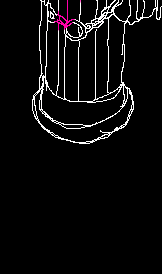
Traditionally red, fire hydrants are omnipresent on every street of a city. In our society red is synonym of danger or emergency. Being one of the most visible color of the spectrum, it catches your attention right away. By painting fire hydrants pink, I just wanted to change the color of an otherwise pretty boring object. I chose pink because I wanted to make a subtle change to the environment. The slight change from red to pink is in fact, a small shift in the color spectrum but it has an immense visual impact. Although not shocking at first this change becomes flagrant once it is noticed by bystanders. Pink is also a pretty visible and flashy color, enough for them not be mistaken with other urban structures.
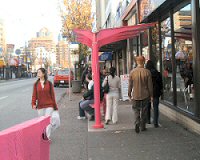
Pink is also a very controversial color. Often “associated with homosexuals and bisexuals” this color is very trendy. In the Vancouver Village, some bus shelters are even painted pink to signify that you are in a queer friendly area of the city.
The fact that fire hydrants have a phallic connotation to them and that firemen are mostly men makes this experiment even more interesting. I was really surprised when i read that “it was not until the 1940s that the modern gender associations with color became universally accepted” and that before that period, blue was for girls and pink was for boys. Another proof that the spectacle induces us into believing the stereotypes we are surrounded by.
Painting the fire hydrants is the first step of my “détournement”. The second step is to leave my painting equipment on the scene of the crime so that somebody can finish off what i have started. By taking part in my actions, this person leaves his state of contemplation to become an actor in this new situation I created, free to paint in pink wherever he wills. I want the bystander to participate in this ongoing project.
The pink fire hydrant project is based on my readings the situationnist doctrine. In their view our society is a mere spectacle where we are compelled to consume. We are spectators to our own lives which are ruled by outside forces. We live what society expects from us and follow footsteps that are already laid out. By creating situations of momentary artistic experiences, situationnists try to disrupt that pattern and, instead of being a spectator, take action in our environment contributing into the permanent revolution of our daily routine.





